





Bonded Warehouse vs Free Zone in Thailand Comparison
Bonded Warehouse vs Free Zone: Key Differences Comparison
For importers, exporters, manufacturers, and logistics companies in Thailand, choosing the right customs facility can have a direct impact on cash flow, tax efficiency, inventory control, and regional competitiveness. Two of the most common options are a bonded warehouse and a free zone. Both can help reduce or defer customs costs, but they are designed for different business models.
A bonded warehouse is typically used to store imported goods under customs control before they are released into Thailand or re-exported. A free zone is usually better suited to export-oriented production, assembly, processing, packing, and regional distribution where imported materials, machinery, or goods are used within a designated customs area.
What Is a Bonded Warehouse?
A bonded warehouse is a customs-approved storage area where imported goods can be kept without immediate payment of import duties. Goods stored in a bonded warehouse remain under the supervision of the Thai Customs Department until they are released, transferred, processed under approved conditions, or exported.
Bonded warehouses are commonly used for imported finished goods, spare parts, consumer products, machinery parts, and other inventory that may later be sold domestically or re-exported. In Thailand, goods may generally be stored for up to two years, with extensions subject to customs conditions.
Key Benefits of a Bonded Warehouse
- Import duty can be deferred until goods are released into the domestic market.
- Duty may be exempted when goods are re-exported under approved conditions.
- Businesses can improve cash flow by avoiding upfront duty payments on stored inventory.
- Goods can be stored, inspected, packed, assembled, mixed, or processed when permitted by customs approval.
- Bonded warehouses are useful for importers, exporters, distributors, and logistics providers handling international goods.
Common Types of Bonded Warehouses
- Storage bonded warehouses for keeping imported goods under customs control.
- Bonded warehouses for display and sale of goods under customs supervision.
- Manufacturing or processing bonded warehouses for approved activities such as assembly, mixing, packing, or other authorized operations.
Bonded Warehouse Use Cases
An importer may store electronics appliances from overseas in a bonded warehouse and pay duty only when the appliances are released to domestic dealers. A logistics company may use a bonded warehouse as a regional distribution hub, holding goods from multiple countries before shipping them to customers in Thailand or abroad.
What Is a Free Zone?
A free zone is a designated customs area where imported goods, raw materials, machinery, equipment, and components can enter with tax and duty privileges, provided they remain within the zone and are used according to approved conditions. Free zones are widely used by export-oriented manufacturers, regional distribution centers, industrial operators, and international logistics businesses.
Free zones are especially useful when a business imports raw materials or machinery for production and then exports finished goods. Duty, VAT, and certain other tax obligations may be exempted or deferred depending on the type of goods, activity, and final destination.
Key Benefits of a Free Zone
- Import duty and VAT benefits may apply to goods, raw materials, machinery, and equipment used inside the free zone.
- Duty is generally payable when goods are moved from the free zone into the Thai domestic market.
- Export-oriented manufacturers can reduce raw material and production costs.
- Free zones support manufacturing, assembly, packing, processing, and international distribution.
- Structured customs systems can make import-export operations faster and more traceable.
Examples of Free Zone Locations in Thailand
- Free zones connected to major airports such as Suvarnabhumi, Don Mueang.
- Free zones in industrial estates and logistics parks.
- Free zones in special economic development areas.
- Free zones linked to Eastern Economic Corridor business and manufacturing activity.
Customs Requirements for Free Zones
Businesses operating in a free zone must obtain the required approval from the Customs Department or relevant authorities. They must also maintain traceable inventory records, accounting systems, customs declarations, and reporting procedures for goods entering or leaving the zone.
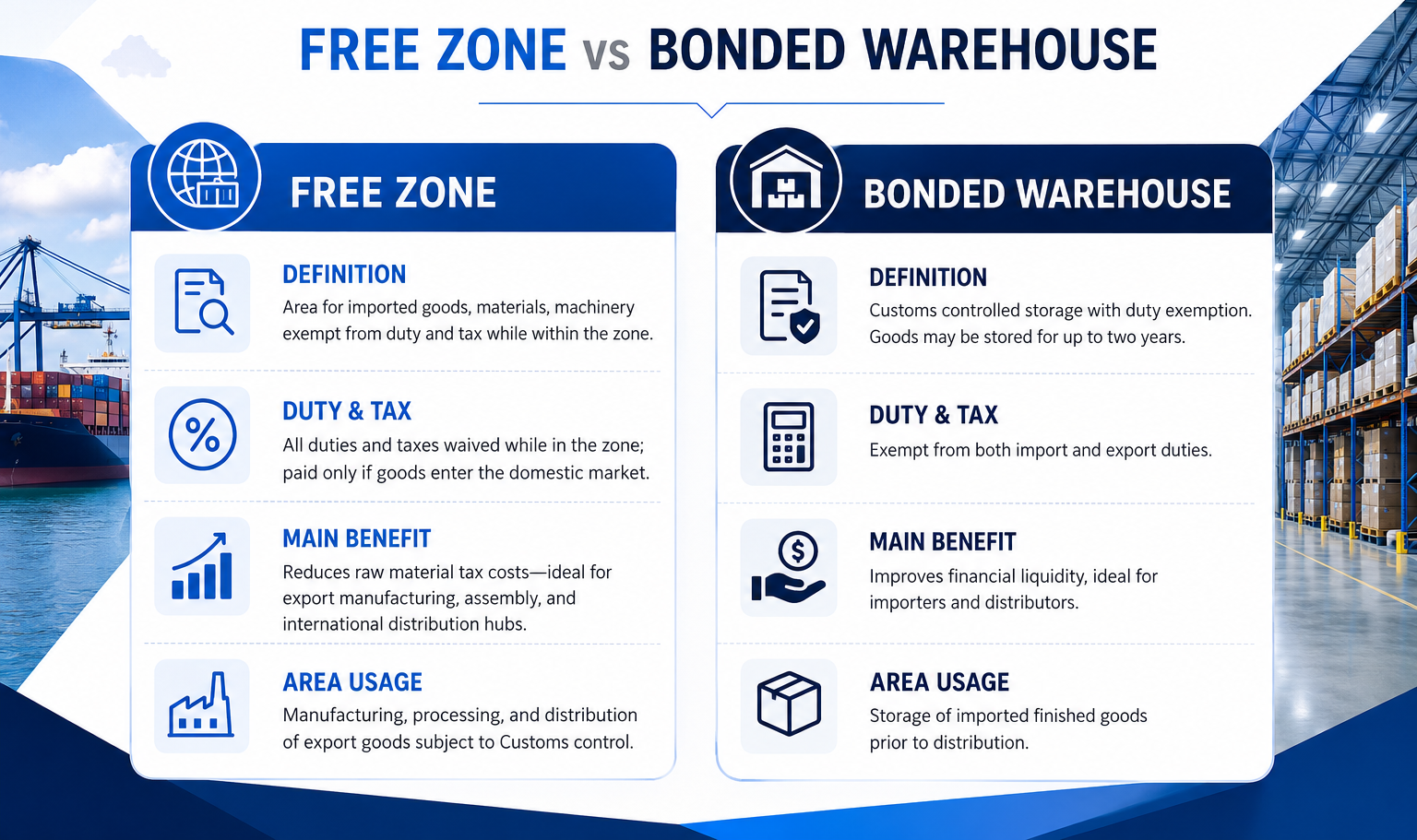
Bonded Warehouse vs Free Zone: Main Differences
Purpose
A bonded warehouse is mainly used for storing imported goods before domestic release or re-export. A free zone is broader and often supports manufacturing, processing, assembly, packing, and export distribution.
Tax Treatment
A bonded warehouse usually provides duty deferment and possible duty exemption when goods are re-exported. A free zone can provide wider duty and VAT benefits for approved goods, machinery, raw materials, and production-related inputs used within the zone.
Best Fit
A bonded warehouse is often best for importers, distributors, trading companies, and logistics providers that need controlled storage before selling or exporting goods. A free zone is often best for export manufacturers, assembly plants, regional distribution centers, and businesses with heavy import-export flows.
Operational Activities
Bonded warehouses support storage and specific approved activities such as packing, assembly, display, or processing. Free zones are usually designed for more integrated industrial and logistics operations, including production, processing, repacking, and cross-border distribution.
Domestic Market Release
When goods from either a bonded warehouse or free zone are released into Thailand’s domestic market, applicable duties, VAT, excise tax, and customs procedures may apply. Businesses should plan their import structure carefully to avoid unexpected compliance costs.
How to Choose Between a Bonded Warehouse and a Free Zone
Choose a bonded warehouse if your main goal is to store imported goods, defer duty payments, inspect stock, manage inventory, or re-export goods without unnecessary upfront tax costs. This option is practical for businesses that import finished goods or components and need flexibility before deciding whether to sell domestically or export.
Choose a free zone if your business focuses on export manufacturing, assembly, processing, packing, or regional distribution. Free zones can offer broader tax advantages when raw materials, machinery, and goods are used inside the zone for approved activities, especially when finished products are exported.
Conclusion
Both bonded warehouses and free zones are valuable tools for managing import-export costs in Thailand. A bonded warehouse is best for customs-controlled storage, duty deferment, and flexible inventory management. A free zone is more suitable for export-driven production, industrial activity, and international distribution with broader tax privileges.
The right choice depends on your business model, product type, storage period, production process, destination market, customs compliance capability, and long-term supply chain strategy. Before making a decision, businesses should review current customs regulations and consult qualified customs or tax specialists to ensure the selected facility supports both compliance and competitiveness.